EN



Horizontal 8-Stage Mechanical Oil Mist Filter - High-Airflow Central System
8-stage deep filtration - 2 x wire mesh + 2 x fiberglass + 2 x fiberglass + 2 x activated carbon, treating oil mist and odour together | 12,000-16,000 m3/h horizontal design for centralized collection from multiple machines | Modular filter elements and a low-resistance layout keep both energy and consumable cost low
- Overview
- Recommended Products
- Eight-stage deep filtration - Two wire-mesh stages, two coarse and two fine fiberglass stages and two activated-carbon stages treat particulate and odour in a single pass.
- 12,000-16,000 m3/h centralized capacity - Sized for a ducted network gathering oil mist from multiple machine tools, not for a single machine.
- Odour and VOC control built in - The activated-carbon stages remove the smell compounds that make oil mist a complaint from adjacent departments, and make recirculation practical.
- Low-velocity horizontal airway - The wide cabinet cross-section spreads the airflow, holding pressure drop down and extending element service intervals.
- Modular filter elements - Each stage sits in its own frame and is replaced or washed independently, so servicing does not require dismantling the whole train.
- Ductwork-friendly layout - Inlet and outlet on the long faces suit connection into an existing centralized exhaust route, including retrofit projects.
- Low running cost - Mechanical filtration with a slow pressure-drop build-up keeps electricity and consumable spend predictable.
- Wire-mesh stages: two stages of 304 stainless-steel woven wire mesh that remove coarse droplets and protect the media downstream; washable and reusable.
- Fiberglass stages: two coarse and two fine fiberglass media stages in modular frames, graded so that each removes the particle band the preceding stage has left behind.
- Activated-carbon stages: two beds of granular activated carbon for odour and light-organic-gas adsorption, arranged as the final stages of the train.
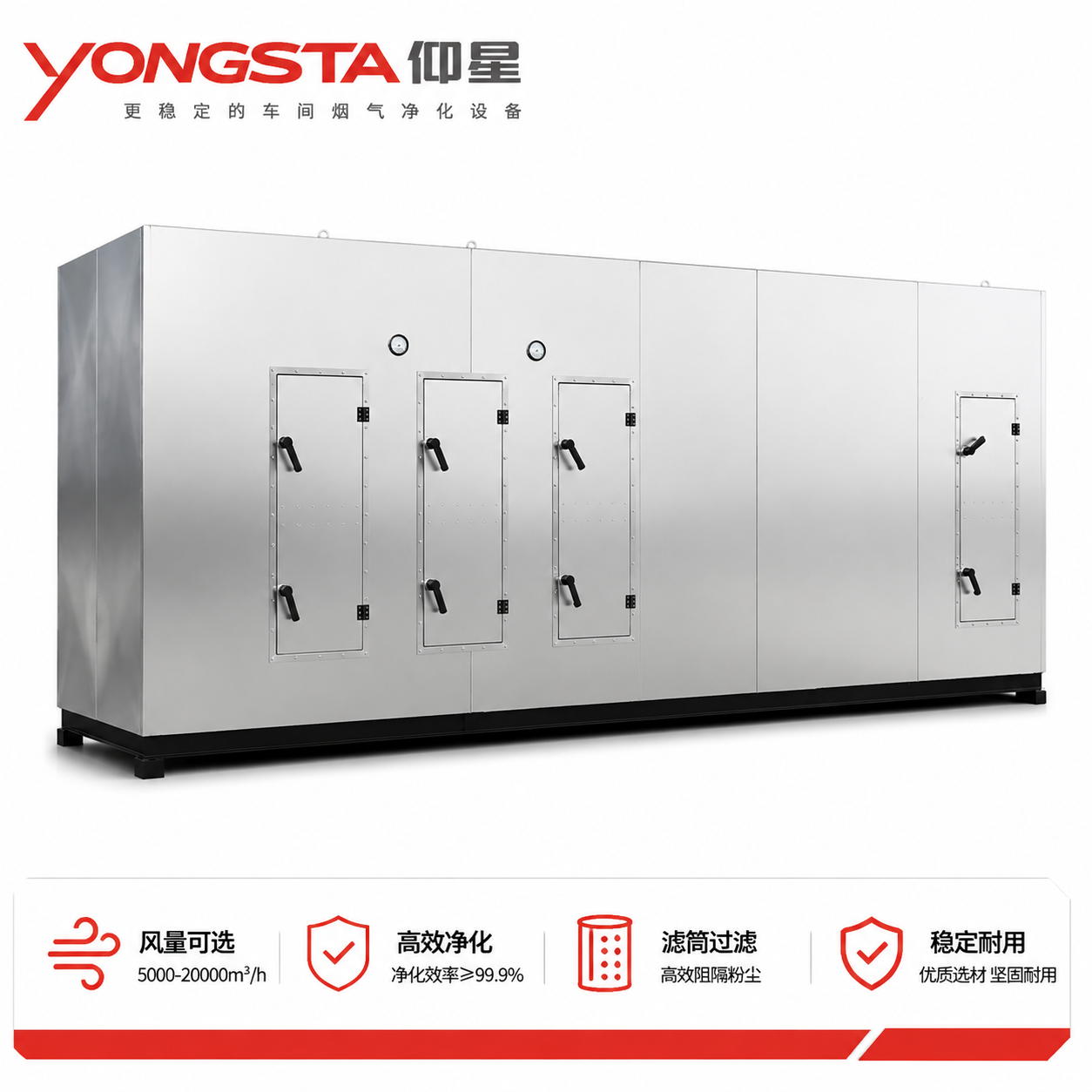
- Cabinet: powder-coated cold-rolled steel sheet with gasketed access panels along the long face for element replacement.
- Filter frames: modular, individually removable, allowing single-element servicing without dismantling the filtration train.
- Material and surface-treatment certificates, together with filtration and media test reports, are available on request.
- Large machining cells - Centralized collection from several machine tools served by a common duct network.
- Heat treatment - Filters quenching and tempering oil smoke where odour control is also required.
- Die-casting shops - Removes release-agent mist and lubricant smoke from a bay of die-casting machines.
- Multi-machine centralized collection - One purifier serving a whole production area through individual capture hoods.
- Large machining workshops - Treats workshop-scale oil mist at 12,000-16,000 m3/h with recirculation to recover heating energy.
- Retrofit projects - The horizontal layout allows the cabinet to be inserted into the route of an existing centralized exhaust system.
- Quenching oil fume - mesh-belt furnaces, quenching oil tanks, bogie-hearth furnaces, pit furnaces and vacuum quenching furnaces
- Metal machining - hardening machines, cutting machines and other machine tools
- Foundry industry - all types of die-casting machines
- Rubber and plastics - pelletising, blown film, extrusion and asphalt product manufacturing
- Agricultural and food processing - frying, boiling, steaming and baking lines in food plants
- Airflow - Standard models at 12,000 and 16,000 m3/h; requirements outside the range are quoted as engineered systems.
- Filter configuration - Number and grade of wire-mesh, fiberglass and activated-carbon stages adjusted to the required duty and discharge cleanliness.
- Activated carbon - Standard granular bed; alternative grades available according to the target odour or VOC compounds.
- Cabinet material - Powder-coated carbon steel as standard; 304 stainless steel on request.
- Voltage and frequency - 380 V / 50 Hz as standard; other voltages and frequencies for export markets.
- Colour - Standard machine grey; any RAL colour available on request.
- System scope - Purifier only, or complete system with capture hoods, ducting, fan, controls and airflow balancing.
- Branding - OEM nameplate, logo and packaging to buyer specification.
- ISO 9001:2015 - Quality management system
- ISO 14001:2015 - Environmental management system
- ISO 45001:2018 - Occupational health and safety management system
- CE marking on export models
- National High-Tech Enterprise certification (China)
- Third-party inspection available through SGS / BV / Intertek
- Material test reports and filtration test reports available on request
- Cabinet: wrapped in PE film and braced on a steel or wooden skid for sea freight; the long cabinet is supported along its full length to prevent bending in transit.
- Filter elements: wire mesh, fiberglass and activated carbon elements packed separately in cartons with foam protection.
- Documentation: packing list, English operation and maintenance manual, and test report supplied with each shipment.
- Port of loading: Qingdao / Tianjin, China.
- Incoterms: FOB / CIF / CFR available.
- Loading reference: TBC - factory to confirm units per 20GP and 40HQ container by model.
Description
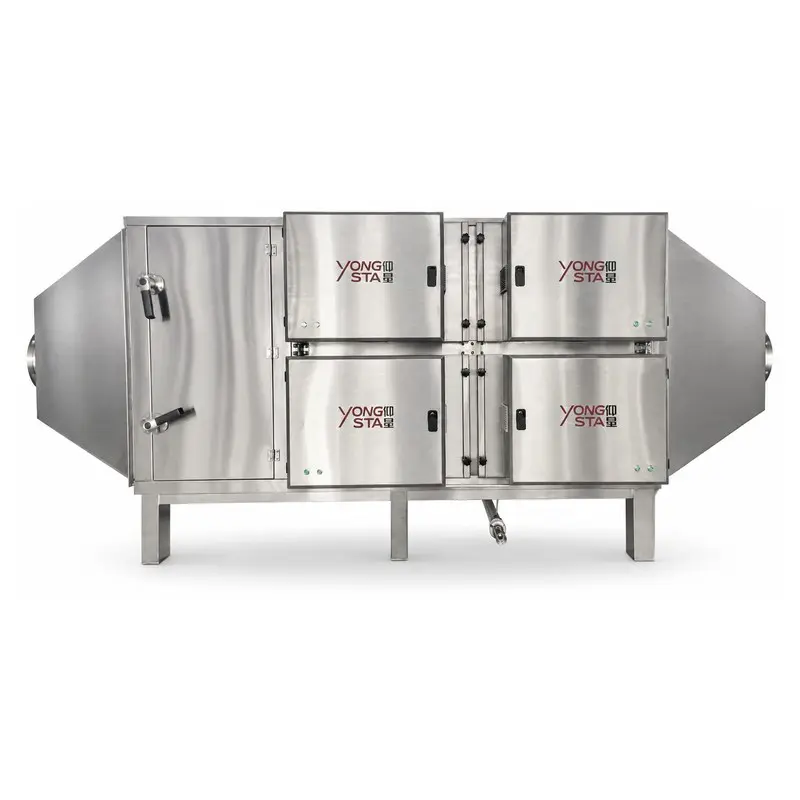
The YONGSTA OFP-M Horizontal Series is a mechanical oil mist filter built for centralized collection. Where a vertical unit is sized to one machine, the horizontal platform is sized to a production bay: 12,000 m3/h on YS-OFP-M120 and 16,000 m3/h on YS-OFP-M160, drawn through a ducted network that gathers oil mist from several machine tools or from a complete machining cell. The low, wide cabinet - 4,500 x 1,000 x 1,400 mm and 4,800 x 1,000 x 1,400 mm - is designed for ductwork connection on both faces and for installation on a service platform or in a plant room, with the long horizontal airway keeping the air velocity low and the pressure drop with it.
Filtration is an eight-stage mechanical train. Two stages of stainless-steel wire mesh remove the coarse droplets and protect the media downstream; two stages of coarse fiberglass capture the bulk of the remaining aerosol; two stages of finer fiberglass take out the sub-micron fraction; and two stages of activated carbon adsorb the odour compounds and light organic gases that make oil mist objectionable to neighbouring departments. Treating odour and particulate in the same cabinet is what makes the horizontal range suitable for recirculating installations: the cleaned air can be returned to the workshop, recovering the heating or cooling energy that would otherwise be exhausted outdoors, instead of simply being moved from one place to another.
Maintenance is based on modular elements. Each filter stage sits in its own frame and can be replaced or washed independently, so a single element can be changed without dismantling the whole train and without taking the plant out of service for long. Because the airflow is spread over a large cross-section, dust and oil loading is distributed evenly and the pressure drop builds slowly, which extends the interval between element changes and reduces both consumption and fan power. The horizontal layout also makes the unit easier to integrate with existing ductwork in a retrofit: the cabinet can often be dropped into the route of an existing central exhaust system. Standard supply is 380 V / 50 Hz three-phase, with other voltages available on request.
Key Features
Format: function word + one quantified or scenario-based description.
Technical Specifications
Model comparison table:
Model |
Power |
Dimensions L x W x H (mm) |
Filtration Stage |
Airflow (m3/h) |
Filter Configuration |
YS-OFP-M120 |
5.5 kW |
4500 x 1000 x 1400 |
8-stage |
12,000 |
2 x SS wire mesh + 2 x fiberglass + 2 x fiberglass + 2 x activated carbon |
YS-OFP-M160 |
7.5 kW |
4800 x 1000 x 1400 |
8-stage |
16,000 |
2 x SS wire mesh + 2 x fiberglass + 2 x fiberglass + 2 x activated carbon |
General specifications (common to the range):
Purification principle |
Eight-stage mechanical interception with odour adsorption: 2 x wire mesh + 2 x fiberglass + 2 x fiberglass + 2 x activated carbon |
Airflow range |
12,000 - 16,000 m3/h |
Oil mist removal efficiency |
97 - 99% |
Odour / VOC removal |
Activated-carbon stages; TBC - factory to confirm service life and removal performance |
Initial / final pressure drop |
TBC - factory to confirm Pa at rated airflow |
Power supply |
380 V / 50 Hz / 3-phase (other voltages and frequencies available on request) |
Cabinet material |
Powder-coated cold-rolled steel sheet |
Fan |
Integrated centrifugal fan matched to the system pressure drop |
Filter replacement |
Wire-mesh and fiberglass stages washable or replaceable; activated carbon replaced on condition |
Materials & Finish
Assembly & Installation
The OFP-M Horizontal Series is delivered as a factory-tested cabinet. Because of its size it is normally positioned with lifting equipment and connected into an existing or newly fabricated duct network.
1. System design - Confirm the total airflow of the connected capture points, the duct route and the required fan static pressure. Centralized systems are sized from a capture drawing and an airflow calculation rather than from machine count alone.
2. Positioning - Set the unit level on a concrete floor, service platform or plant room floor, leaving clearance along the access face for element removal and enough headroom for lifting equipment.
3. Duct connection - Connect the collection duct network to the inlet and route the outlet to the return-air grille or outdoor discharge. Balance the branches so that each capture point gets its design airflow, and keep duct velocity high enough to prevent oil condensing in the duct.
4. Electrical connection - Wire the fan through an isolator, earth the cabinet, and confirm rotation and running current against the nameplate.
5. Commissioning - Measure and record the airflow at each capture point and the pressure drop across the filter train. The initial pressure drop figure is the reference for all future element-change decisions.
6. Operator training and handover - Demonstrate how each filter stage is removed and replaced, how the drain is emptied and how to read the pressure-drop indicator. Hand over the maintenance schedule and spare-element list.
Tools required: standard hand tools, lifting equipment (cabinet length up to 4,800 mm), and ducting materials. Typical installation time: 2-3 working days including duct connection and airflow balancing.
Applications
Customization Options
Certifications
Packing & Logistics
FAQ
Q: When should I choose a horizontal unit instead of a vertical one?
A: When the oil mist comes from a group of machines rather than one. Vertical units are sized to a single machine and stand beside it; the horizontal range is sized to a ducted network at 12,000-16,000 m3/h and is installed on a floor or platform where the ductwork converges. If you are deciding between the two, send us a plan of the machines and we will compare the options.
Q: Why are activated-carbon stages included?
A: Because oil mist is not only a particulate problem. The odour compounds that make neighbouring departments complain, and the lighter organic gases that can be regulated as VOC, are not removed by mechanical media. The two activated-carbon stages in the horizontal range adsorb them, which is what allows the cleaned air to be recirculated rather than simply exhausted.
Q: How do I know when to change the filter elements?
A: By pressure drop. Record the pressure drop across each stage at commissioning, then inspect and replace when it approaches the figure in the maintenance manual. Because the horizontal cabinet has a large cross-section, loading is spread evenly and the pressure drop builds slowly, so elements last longer than on a compact unit of the same airflow.
Q: Can the horizontal range recirculate air back into the workshop?
A: Yes - recirculation is the main reason for specifying the eight-stage train with activated carbon. Returning the cleaned air to the shop recovers the heating or cooling energy that would otherwise be lost, provided element condition is monitored and the maintenance schedule is followed.
Q: Can the unit be fitted into an existing exhaust system?
A: In many cases yes. The low, wide cabinet with inlet and outlet on the long faces is designed to be inserted into a duct route, which makes it a practical retrofit where a plant room or service platform already exists. Our engineers will check the available pressure from your existing fan before confirming.
Q: What is the minimum order quantity and lead time?
A: Minimum order quantity is one unit for standard models; customised and OEM configurations are quoted individually. Lead time depends on the model and quantity - please contact us for a confirmed schedule.
Q: What maintenance does the unit need?
A: Wash or replace the wire-mesh and fiberglass stages on the pressure-drop trigger, replace the activated-carbon beds on condition, empty the oil drain, and check the fan for balance and current draw. Each element is individually accessible from the long face of the cabinet. A full schedule is supplied with the English operation and maintenance manual.
Commercial Parameters 产品商业参数
Parameter |
Details |
MOQ |
1 unit for standard models; TBC for OEM / customised configurations |
Lead time |
TBC - factory to confirm; typically subject to order quantity |
Payment terms |
T/T, L/C at sight (to be confirmed) |
Warranty |
1 year |
Spare parts |
Wire-mesh element, coarse and fine fiberglass elements, activated-carbon element, drain components |
Loading |
TBC - units per 20GP / 40HQ by model |
Appendix - Shared Category Content
The section below is shared category-level content. It is identical in every product document of this category and only needs to be published once, on the category page.
Category: Oil Mist & Fume Purification Equipment
Category Introduction
Oil mist, coolant aerosol, heat-treatment smoke are the most persistent and least visible hazards in a modern metalworking plant. Every turning, milling, grinding, EDM, cold-heading, die-casting operation discharges a fine aerosol of metalworking fluid, metal oxide and pyrolysis products into the shop air. Most of these particles measure between 0.3 and 5 microns, which is small enough to stay suspended for hours, to travel the full length of a workshop with the general ventilation, and to reach deep into the lungs of operators working dozens of metres from the source. Left uncontrolled, the same aerosol coats machine tools, lighting and roof structure, degrades electrical cabinets, raises cleaning and maintenance costs, and creates a genuine fire and slip risk around the plant. In cold weather the problem becomes worse: as buildings are closed up and fresh-air rates are reduced to save heating energy, oil mist concentration in the breathing zone rises sharply, and the cost of the ventilation solution becomes a production issue rather than a compliance one. That is why oil mist and fume purification equipment has moved from being an optional accessory to a standard part of the machine-tool package in Europe, North America and, increasingly, in the Middle East and South-East Asia.
This product series is designed primarily for oil mist and oil fume with a high water content. Typical operating conditions are the machining industry, where water-miscible cutting fluids and coolants are used, together with the other wet or emulsified aerosol sources found in metalworking plants. Where the aerosol is predominantly water-based, the purification train is selected so that the moisture load does not degrade filtration performance or shorten element life, and so that the collected liquid can be drained and disposed of cleanly. Buyers should state the coolant type and the water-to-oil ratio of their process when requesting a selection, because it determines both the filtration stages and the drainage arrangement of the unit.
Occupational exposure limits are the main driver of demand. Metalworking fluids are associated with occupational asthma, hypersensitivity pneumonitis and dermatitis, and regulators have responded with progressively tighter limits on total particulate and oil mist in the breathing zone - typically 0.5 to 5 mg/m3 depending on jurisdiction. For welding, the target is usually hexavalent chromium, manganese and nickel compounds rather than the total fume mass, which is why filtration efficiency on the sub-micron fraction matters far more than a headline capture rate. Buyers should therefore expect a supplier to quote efficiency at a stated particle size, to explain how the installed unit is verified, and to provide material and filtration test reports on request. Equipment that merely moves the aerosol from inside the operator's breathing zone to the roof void is no longer acceptable in most markets: the discharge has to be demonstrably clean, and in many cases it also has to be returned to the workshop in order to recover heating energy.
Three purification principles dominate the market, and the best industrial equipment combines them. Mechanical filtration uses progressively finer barrier media: labyrinth or corrugated baffles to knock out the largest droplets, stainless-steel wire mesh, medium-efficiency pocket or bag filters, and finally HEPA/H13-grade glass-fibre media for the sub-micron tail. Mechanical filtration is robust, needs no high voltage and is easy to validate, but the media has to be replaced or washed periodically and deep beds create pressure drop that pushes fan power up. Electrostatic precipitation (ESP) first gives each particle an electric charge in a high-voltage ionising field, then collects it on grounded plates. Because the collecting force acts on the particle itself rather than on a pore, ESP units achieve high efficiency across the 0.1-10 micron oil mist range at very low pressure drop, and the collection cells are metal, washable and effectively permanent. ESP is the technology of choice for high-airflow, heavy-load duty such as heat treatment, die casting and centralised oil mist treatment for multiple machines. Activated carbon adsorption is added downstream when odour, VOC or process gases must be controlled as well as particulate - for example over high-temperature pyrolysis smoke or paint overspray. A properly specified purifier therefore reads as a train: pre-filter, main filter or ESP, final filter, carbon, fan. The order matters, the efficiency of each stage matters, and the pressure-drop budget determines which fan the plant ends up paying for.
Sizing is where most projects succeed or fail. The purification unit must be matched not only to the total airflow of the capture points but to the capture method itself: full enclosure, close-fitting local exhaust, side-draft hood, or push-pull ventilation across a large bay. Enclosure and close-capture designs reach the same protection level with far less airflow, which reduces both capital and running cost. Once airflow is fixed, the design must respect pressure drop, duct velocity - oil mist must stay above roughly 8-10 m/s in horizontal runs or it will condense inside the duct - and the return-air path. Discharging indoors recovers heating energy but requires the air to genuinely meet the relevant cleanliness target; discharging outdoors avoids that burden but wastes energy and may still be regulated. Because these decisions depend on the plant rather than the catalogue, YONGSTA sizes each project from a capture drawing and an airflow calculation, and supplies the purifier as part of a complete system rather than as an isolated box.
Choosing between the two families usually comes down to airflow, load and layout rather than to price. Mechanical oil mist filters are the natural choice for a single machine tool or a small group of machines: they need no high-voltage power pack, the elements can be washed and reused, and the vertical models fit into the narrow strip of floor beside a machine. Electrostatic units take over where the airflow is large or the load is heavy, including commercial kitchen exhaust, heat treatment, die casting, or a ducted network gathering mist from many machines - because they achieve high efficiency on sub-micron aerosol with very low pressure drop and no disposable media in the main stage. Many workshops end up using both: electrostatic purifiers on the high-airflow central systems, and mechanical units on machines that are remote from the central duct or that run intermittently. What matters is that the equipment is sized from a capture drawing and an airflow calculation. For a quotation, send us the machine list or a plan of the workshop, the capture method you intend to use and the installation position or space available for the purification unit, the available supply voltage, the required discharge route (recirculation or outdoor), and any local exposure limit that the purified discharge has to meet. With those five pieces of information our engineers can size the purifier, the fan and the ductwork, and give you a system price rather than a box price.
YONGSTA - Yongsta Environmental Technology (Shandong) Co., Ltd. - designs and manufactures industrial dust, fume and oil mist purification equipment at a 3,000 m2 production base in Shandong, China, supported by a research and manufacturing team whose roots go back to 2015. The company is a National High-Tech Enterprise with more than 30 patents and software copyrights, and operates a quality management system certified to ISO 9001, an environmental management system certified to ISO 14001, an occupational health and safety management system certified to ISO 45001, and holds CE certification on its export models. Products are supplied to more than 30 countries and to industrial customers including Siemens, Sinopec, CNOOC, Baowu Magnesium, China Railway No. 4 Engineering Group and other large manufacturing groups. For export buyers YONGSTA supplies the complete survey-design-manufacture-installation-service chain, English technical documentation, and factory acceptance testing before shipment.